

Share This Article
This post contains affiliate links. If you buy through them, we may earn a commission at no extra cost to you. See our disclaimer for details.
Your knees ache on the stairs, there’s a heating pad in the closet that’s helped for years, and your feed keeps showing a red-glowing strap promising joint relief. So which one deserves your evenings? In the red light therapy vs heating pad question, the short version is that they work in different ways: a heating pad warms tissue to ease stiffness, while a device like the Kineon MOVE+ shines red and near-infrared light into the joint without heating it.
This guide explains how each works, what research actually shows for joint pain, and who the MOVE+ may (and may not) suit. Like everything on Simple Health Blog, it’s general information, not medical advice, so check with your doctor before starting anything new for joint pain.
Quick answer: A heating pad warms tissue to ease stiffness quickly, and it’s cheap and well understood. The Kineon MOVE+ uses red and near-infrared light, not heat. Research on light therapy for joint pain is promising but mixed, so it isn’t proven to be better. It may suit people wanting a portable daily option.
Red Light Therapy vs Heating Pad: What’s the Difference?
The difference is heat versus light: a heating pad raises the temperature of your skin and the tissue under it, while red light therapy delivers low-level light that isn’t meant to warm you at all.
| Feature | Heating pad | Red light therapy |
|---|---|---|
| How it works | Warms skin and nearby tissue, increasing blood flow | Low-level red and near-infrared light absorbed by cells (photobiomodulation) |
| How it feels | Noticeable, soothing warmth | Little or no sensation; some people notice mild warmth |
| Speed of relief | Often within one session, short-lived | Usually builds over weeks of regular sessions, if it helps |
| Evidence for joint pain | Well established for stiffness and short-term pain relief | Promising but mixed, especially for knees |
| Typical cost | Usually much cheaper | Wearable devices often cost hundreds of dollars |
Think of a heating pad as fast comfort for stiffness, and red light therapy as a slower, regular routine that some people add when heat isn’t enough or isn’t practical.
How Does a Heating Pad Help Joint Pain and Stiffness?
Warmth increases blood flow and relaxes the muscles around a stiff joint, which can make it easier to move and less sore.
Cleveland Clinic’s sports medicine and rheumatology experts explain that heat improves circulation to tight muscles and can help a joint that “isn’t moving well” regain range of motion (Cleveland Clinic, February 2025).
Where heat helps most
Heat tends to work best for long-running stiffness rather than fresh injuries:
- Arthritis stiffness: Rheumatologist Linda Mileti, MD, notes that “patients with more chronic osteoarthritis usually feel better with heat,” and moist heat can be especially soothing.
- Tight muscles around the joint: Knots and tension in the muscles that support a knee, hip or shoulder often loosen with warmth.
- Lingering stiffness: Once any swelling from an old strain has settled, heat can help ease the stiffness that follows.
The research backs heat for short-term relief too. A Cochrane review of heat for low back pain found “moderate evidence that heat wrap therapy reduces pain and disability” in the short term (French et al., Cochrane, 2006).
When heat is the wrong choice
Heat can make some problems worse, so skip the heating pad in these situations:
- A new injury: For a fresh sprain, strain, or bump, Cleveland Clinic recommends ice first, because heat “may actually make an injury feel worse at first.”
- Swelling or a hot, red joint: These signs point to inflammation, and a hot, swollen joint needs a doctor’s check.
- Reduced sensation: If you have neuropathy or diabetes, you may not feel when a pad gets too hot, so use extra caution.
Whatever the reason, keep heat sessions to about 20 minutes at a time.
How Does Red Light Therapy Work on Joints?
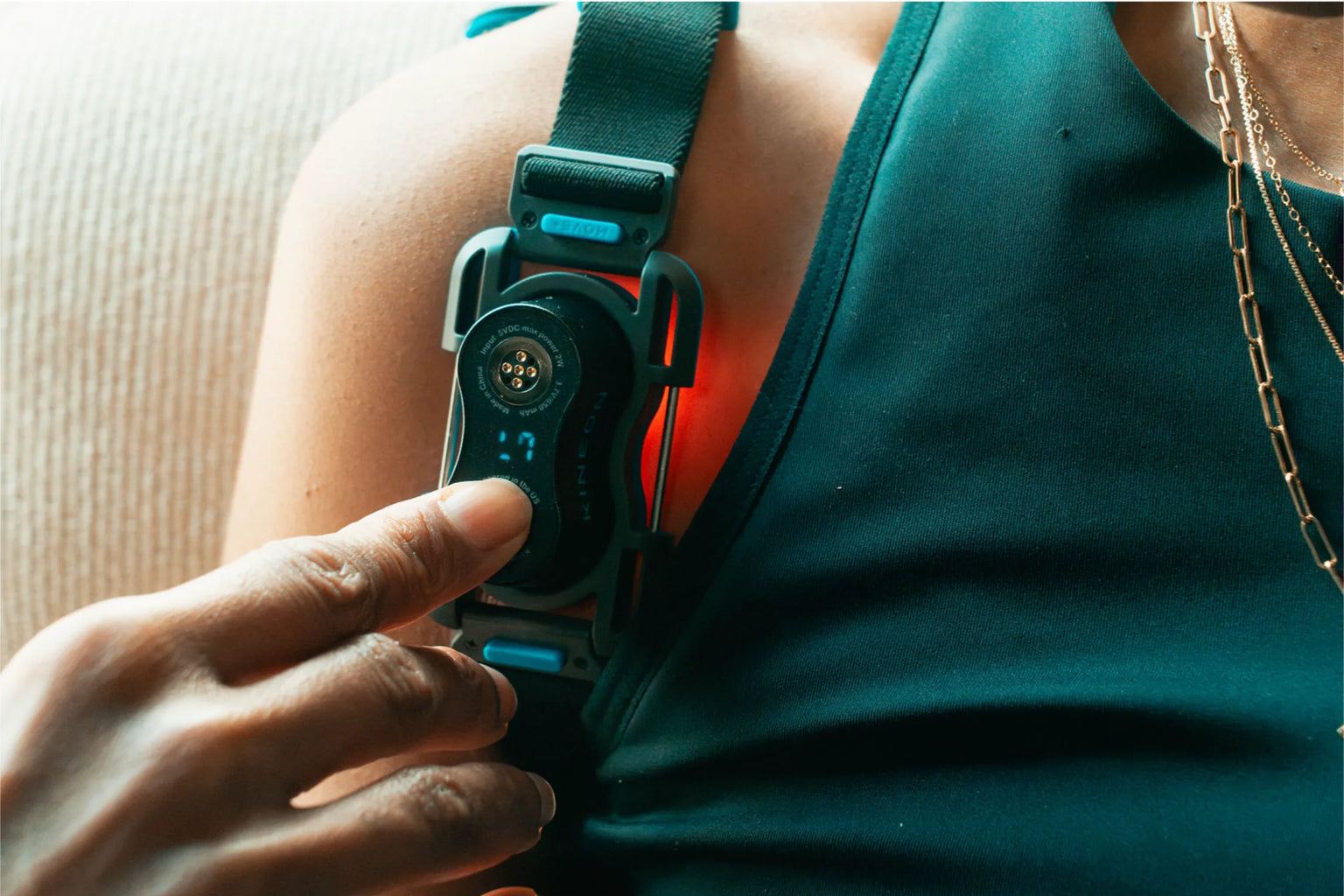
Red light therapy, also called photobiomodulation, uses low-level red and near-infrared light that passes through the skin, where it’s absorbed by cells.
The leading theory is that this light acts on the energy-producing parts of cells and may influence inflammation and tissue repair. Cleveland Clinic notes the treatment shows potential for some conditions but that more studies are needed. Red light therapy doesn’t use ultraviolet (UV) light, so it isn’t the kind of light that causes sunburn, and it’s different from a red heat lamp, which works mainly by warming you.
University Hospitals (June 2025) notes that red light devices typically deliver wavelengths between 630 and 850 nm, which covers deep red and near-infrared light.
Does red light therapy get hot?
Red light therapy isn’t designed to heat your tissue. Kineon says some MOVE+ users notice mild warmth or temporary redness that usually fades quickly, but the device has no heat setting.
What Is the Kineon MOVE+?

The Kineon MOVE+ is a wearable strap with three light modules that combine 660 nm red LEDs and 808 nm near-infrared lasers, worn over a joint for short daily sessions.
According to Kineon’s product page (checked November 6, 2026):
- Light: Each module has 8 deep-red LEDs at 660 nm and 10 near-infrared Class 1 laser diodes at 808 nm.
- In the box: A travel case, 3 modules, an Adjustable Strap 3.0, a charge case, a charging cable, a user manual, and a quick start guide. The Extender Strap is sold separately.
- Sessions: Kineon recommends 10 to 15 minutes daily, with a maximum of twice a day.
- Battery: Each module lasts about 4 hours of use (around 24 ten-minute sessions), and a full charge takes about 3.5 hours.
- Body areas: Kineon lists the knee, back, neck, ankle, shoulder, head, elbow, and hip.
You may also see it called the “MOVE+ Pro,” a name that appears in its FDA listing and in many reviews. The Kineon MOVE+ price changes with Kineon’s promotions, so check it before you buy.
Is the Kineon MOVE+ FDA-cleared?
The MOVE+ is FDA-registered rather than FDA-cleared or approved, which are distinct regulatory designations. A search of the FDA’s 510(k) database (via openFDA, November 6, 2026) shows no separate clearance under Kineon. Instead, FDA registration and listing data confirm that “KINEON MOVE+” is properly listed through a third-party manufacturer within the infrared therapeutic lamp product category.
How much does the Kineon MOVE+ cost?
At the time of writing (November 6, 2026), the MOVE+ costs $399 on Kineon’s site, down from a list price of $699 in an Early Black Friday promotion with free shipping. A bundle with Kineon’s Relief+ tool and the Extender Strap costs $599.
Other buying details Kineon lists:
- Payment: Pay-over-time options through Affirm and Klarna.
- Trial: Kineon’s refund policy offers a 30-day satisfaction guarantee. It asks for consistent daily use over 30 days and refunds the device price, excluding shipping.
- Warranty: 1 year.
- HSA/FSA: Kineon says the MOVE+ is HSA/FSA eligible. Check with your plan before you buy.
Prices change often, so confirm the current offer before ordering.
Is Red Light Therapy Better Than a Heating Pad for Joint Pain? What the Evidence Says
Red light therapy isn’t proven better than a heating pad. Heat has decent evidence for short-term relief at a low cost, while research on light therapy for joint pain is growing but mixed, especially for knees.
The evidence for heat
Heat is one of the oldest, simplest pain tools, and the research supports it for short-term relief. The 2006 Cochrane review found moderate evidence that heat wraps reduce pain and disability from low back pain lasting under three months, though the benefit was small and short-lived. For arthritis, Cleveland Clinic’s rheumatologists recommend heat for stiffness. What heat doesn’t do is change the underlying joint; it eases symptoms while you use it.
The evidence for red and near-infrared light
A 2021 review by de Oliveira and colleagues in the European Journal of Physical and Rehabilitation Medicine found that low-level laser and LED therapy can relieve pain in several common musculoskeletal conditions (de Oliveira et al., 2021). The details are more cautious:
- Knee pain: Evidence for non-specific knee pain came from a single trial of 86 patients, and the authors call it an area that needs more research.
- Knee osteoarthritis: Some trials found light therapy plus exercise was no better than placebo, while a larger pooled analysis found pain relief when recommended doses were used.
- Conflicts of interest: Two of the authors have ties to a laser device manufacturer.
Cleveland Clinic’s overall view is that “there’s not enough evidence to support most uses” yet. Orthopedic sports medicine physician Jacob Calcei, MD, of University Hospitals, is more hopeful: he says red light therapy “seems to offer potential benefits to patients with chronic pain issues” and calls it “very reasonable to try,” while stressing that “if you have advanced osteoarthritis, nothing has been shown to reverse it.”
Does Kineon red light therapy work?
There’s no independent published trial of the MOVE+ itself, so the research on red and near-infrared light in general is the best guide. Kineon’s science page summarises studies on light therapy in general, which helps explain the mechanics.
User feedback leans positive. Many Trustpilot reviewers describe less knee or back pain and praise Kineon’s customer support, while the most common complaints are about shipping. Independent reviewers have generally liked the strap design and ease of use. Results vary from person to person, so the 30-day trial gives you time to judge it for yourself.
Kineon MOVE+ vs Heating Pad: Side-by-Side Comparison
The MOVE+ is a portable, heat-free light device with a 30-day trial, while a heating pad is a cheap, familiar source of warmth with stronger evidence for quick relief.
| Feature | Kineon MOVE+ | Heating pad |
|---|---|---|
| How it works | Red (660 nm) and near-infrared (808 nm) light | Warmth from an electric element |
| Heat | No heat setting; some feel mild warmth | Yes, adjustable settings on most models |
| Session length | 10 to 15 minutes, up to twice daily (per Kineon) | About 20 minutes at a time |
| Portability | Cordless, wearable strap | Usually plugged in; you sit or lie still |
| Price | $399 (November 6, 2026, promo price) | Usually much cheaper |
| Evidence for joint pain | Promising but mixed; no MOVE+-specific trial | Moderate evidence for short-term relief |
| Main safety point | Don’t look into the lights; follow directions | Burn risk, especially with reduced sensation |
| Trial or warranty | 30-day guarantee, 1-year warranty (per Kineon) | Varies by brand |
Kineon’s site lists the current MOVE+ price and trial terms, which change during sales.
The table shows a trade-off: the heating pad wins on cost and proven comfort, and the MOVE+ wins on portability and the absence of heat. Neither has strong evidence that it changes the joint itself.
Red Light Therapy vs Heating Pad: Which Should You Choose?
For most everyday stiffness, a heating pad is the sensible first choice, and red light therapy is an option to consider if heat isn’t enough or doesn’t fit your day.
| Situation | Usually the better first choice | Why |
|---|---|---|
| New injury or swelling | Neither; use ice and see a doctor if needed | Heat can worsen fresh inflammation |
| Everyday stiffness on a budget | Heating pad | Cheap, quick comfort with decent evidence |
| You want relief at work or on the go, without heat | MOVE+ may suit | Cordless and wearable during short daily sessions |
| Ongoing knee or shoulder pain your doctor already manages | Ask your doctor about adding light therapy | It may complement care, but evidence is mixed |
| Sensitive skin, neuropathy, or diabetes | Talk to a doctor first | Burn risk with heat; check guidance for light devices |
Can You Use the Kineon MOVE+ and a Heating Pad Together?
Don’t use them on the same spot at the same time. Some people use heat in the morning for stiffness and a light device at another time of day, but there’s no evidence that combining them works better than either alone.
Follow each device’s own directions, keep heat sessions to about 20 minutes, and stop if your skin becomes red, sore, or uncomfortably warm.
What Are the Downsides and Safety Risks of Each?
Heating pads mainly carry a burn risk, while red light therapy’s main downsides are cost, the time it takes, and limited long-term data.
Heating pad risks
- Burns: The biggest risk, especially if you fall asleep on a pad or have reduced feeling in the area.
- Session length: Keep it to about 20 minutes, and remove the pad if the area gets uncomfortably warm (Cleveland Clinic).
- Skin damage: Don’t use heat on broken skin, a fresh injury, or a swollen joint.
Red light therapy and MOVE+ downsides
- Cost: At $399 on promotion, the MOVE+ costs far more than a heating pad.
- Time: Kineon recommends daily sessions, and any benefit usually takes weeks to notice.
- Mixed evidence: Research doesn’t yet show it works better than simpler options for most people.
- Eye safety: Don’t look directly into the LEDs or lasers. Cleveland Clinic warns that misuse can damage the skin or unprotected eyes.
- Unknown long-term effects: Cleveland Clinic notes that long-term safety hasn’t been fully studied.
- Who should check first: People who are pregnant, who are sensitive to light or who take light-sensitising medicines should ask a doctor and read the device manual before use.
When to Talk to a Doctor
See a doctor before relying on any home device if your joint is hot, swollen or red, if pain started after a fall, or if you have numbness, weakness, fever or pain that keeps getting worse.
Talk to your doctor before trying a new device too if you’re pregnant, have diabetes or neuropathy, or take medicines that make you sensitive to light. Gentle movement often helps alongside heat or light; if your back is part of the problem, see whether walking for back pain fits your routine, and use how many steps is a 30-minute walk to set a realistic daily goal.
Frequently Asked Questions
Does Kineon red light therapy work?
Research on red and near-infrared light for joint pain is promising but mixed, and no independent trial of the MOVE+ itself was found. Many users report less pain, but results vary. Kineon’s 30-day trial lets you test it, though shipping isn’t refunded.
Is the Kineon MOVE+ FDA approved?
No. Kineon says the MOVE+ is FDA-registered, which is not the same as FDA approval or clearance. A search of the FDA’s 510(k) database on November 6, 2026, found no clearance under Kineon.
What are the differences between the Kineon Move+ and Move+ Pro?
Kineon’s site currently sells one device, called the MOVE+. The “MOVE+ Pro” name appears in many reviews and in the FDA’s listing alongside “MOVE+” for the same line. Older versions are sometimes sold refurbished, so check which model you’re buying.
Is red light therapy better than a heating pad for knee pain?
It isn’t proven better. In the red light therapy vs heating pad comparison for knees, heat eases knee stiffness quickly and cheaply, while evidence for light therapy on knee pain is limited, according to a 2021 review. Some people still prefer a heat-free, portable option they can wear during the day.
Does the Kineon MOVE+ get hot?
The MOVE+ has no heat mode and isn’t designed to warm your tissue. Kineon says some people notice mild warmth or temporary redness during or after a session, which usually fades quickly.
What is the downside of red light therapy?
The main downsides are cost, the need for regular sessions over several weeks, mixed evidence for many uses, eye safety, and unknown long-term effects. University Hospitals’ Dr. Calcei sums up the risk as being “more to your wallet.”
Is infrared heat better than a heating pad?
An infrared heating pad is still a form of heat therapy, which is different from the low-level light the MOVE+ uses. There’s no strong evidence that infrared heating pads relieve pain better than regular ones, so choose based on comfort and safety features.
Conclusion
In the red light therapy vs heating pad choice, a heating pad is the cheap, familiar first step for joint stiffness, with real evidence for short-term relief. The Kineon MOVE+ is a portable, heat-free option backed by promising but mixed research, a 30-day guarantee, and a $399 promo price at the time of writing. It may be worth trying if heat isn’t enough or doesn’t fit your day, but neither device replaces a proper diagnosis. If you’d like to try it, see the MOVE+ price and trial terms before you decide.
How we research and review our articles: see our editorial policy.
