


Share This Article
Is mustard good for you? Yes. Plain mustard is one of the healthiest condiments you can put on your plate, with about 3 calories per teaspoon and practically no fat or sugar. So if you’ve been squeezing it onto everything while trying to eat lighter and wondering where the catch is, here it is: some types carry a fair bit of sodium, and honey mustard brings added sugar. That’s about it.
This guide walks you through the real benefits, the best type to buy, how mustard compares with mayo and ketchup, whether it helps with cramps, and how much is OK in a day. Nutrition numbers in this Simple Health Blog guide come from USDA FoodData Central, and each health claim links to the study behind it.
Mustard Nutrition Facts: What’s in One Teaspoon?
One teaspoon (5 g) of yellow mustard has about 3 calories, less than half a gram of fat (labels round it to 0), almost no sugar, and about 55 mg of sodium.
| Nutrient | 1 tsp (5 g) | 1 tbsp (15 g) |
|---|---|---|
| Calories | 3 | 9 |
| Fat | 0.2 g | 0.5 g |
| Carbs | 0.3 g | 0.9 g |
| Fiber | 0.2 g | 0.6 g |
| Sugar | 0.05 g | 0.1 g |
| Sodium | 55 mg | 165 mg |
| Selenium | 1.7 mcg (3% DV) | 5 mcg (9% DV) |
| Magnesium | 2.4 mg (under 1% DV) | 7 mg (2% DV) |
Yellow mustard, prepared. Source: USDA FoodData Central, entry 172234. DV = Daily Value.
The selenium and magnesium are real, but at condiment portions they add very little. A tablespoon covers less than a tenth of your daily selenium, so think of mustard as a smart swap, not a nutrient source.
What’s in the bottle? Classic yellow mustard is ground mustard seed mixed with vinegar, water, and salt. Turmeric gives it that bright yellow color, and a little paprika or garlic often goes in for flavor.
Health Benefits of Mustard: Is Mustard Good for You?
The biggest proven benefit of mustard is simple: lots of flavor for almost no calories. Most other benefits come from lab and animal studies on seeds and extracts, so each one below says what kind of study it rests on.
A Low-Calorie Way to Add Flavor
Swapping creamy sauces for mustard cuts calories fast, and plain nutrition data backs this one up.
On a turkey sandwich, one tablespoon of regular mayo adds about 94 calories, while a tablespoon of yellow mustard adds about 9, based on USDA figures. That one swap saves around 85 calories per sandwich. Do it five days a week, and it adds up to roughly 425 calories.
It’s the same idea as picking air-popped healthy popcorn for weight loss over a buttery movie-theater tub.
Glucosinolates and Antioxidants
Mustard seeds are rich in glucosinolates, sulfur compounds also found in broccoli and cabbage. The main one in mustard seed is sinigrin. When the seed is crushed and mixed with water, it turns into allyl isothiocyanate (AITC), the compound behind mustard’s sharp bite.
A 2022 review in Bioengineering found AITC slowed cancer cell growth in cell and animal studies (lab and animal evidence), with no proof yet in people. A 2023 systematic review in Nutrients covered how people absorb these compounds from cruciferous foods, not what a squeeze of mustard does.
May Give Metabolism a Small, Short-Term Boost
Mustard may nudge your metabolism up a little after a meal, but in the two human studies on it, the effect was small and short.
In an early 1986 study by Henry and Emery (human study), six young men ate a meal with 3 g of chili sauce and 3 g of mustard sauce added. Their metabolic rate ran about 25% higher over 2.5 hours than with the plain meal. Mustard and chili were eaten together, so mustard’s own effect is unknown.
A cleaner test came in a 2013 trial in the British Journal of Nutrition (human study). Twenty-two young men ate 21 g of mustard (about 4 teaspoons) with a meal. Calorie burn over 4 hours ran about 14% higher than with no spice, but the difference wasn’t statistically significant, and appetite didn’t change. Mustard isn’t a weight-loss food.
Antibacterial Activity in Lab Studies
In lab dishes, AITC from mustard kills some food-poisoning bacteria. A 2000 study in the Journal of Food Protection (lab study) found it was active against Salmonella, E. coli O157:H7, and Listeria.
Food scientists study it as a natural preservative, but it hasn’t been shown to fight infections in people.
Mustard Seeds and Greens vs the Condiment
Most mustard studies tested whole seeds, greens, or concentrated extracts, often at doses far larger than you’d ever squeeze onto food.
A teaspoon of prepared mustard is mostly vinegar and water with a little seed, and mustard greens are a leafy vegetable, a different food altogether. So when you see a headline benefit, check whether the study used the seed, the greens, or an extract.
Which Mustard Is Healthiest?
Plain yellow and Dijon are the best everyday picks. Check the sodium on the label, and treat honey mustard more like a sweet sauce than a plain condiment.
Dijon vs Yellow Mustard: Which Is Healthier?
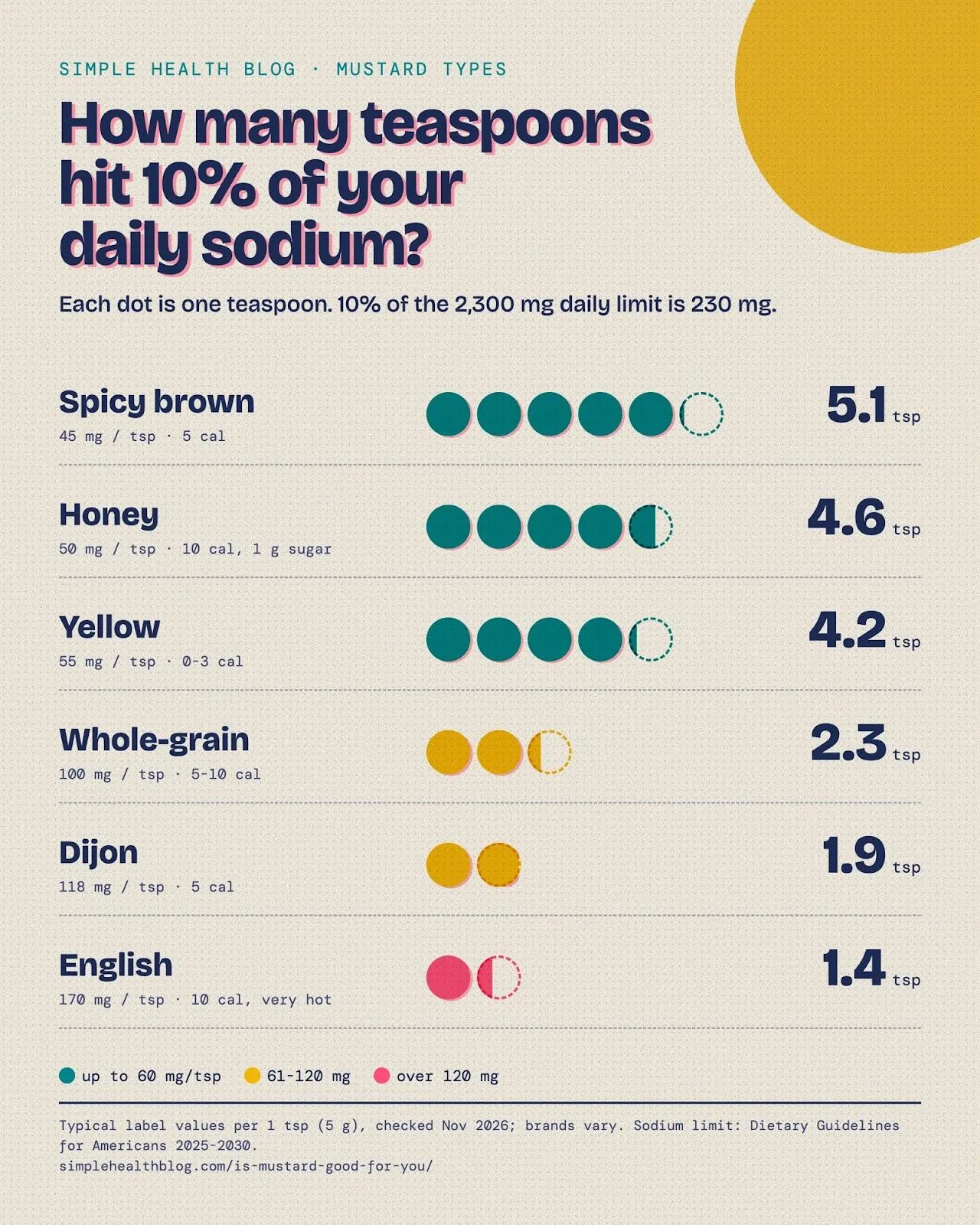
Yellow mustard is usually a little healthier on paper, because it has about half the sodium. A teaspoon of typical yellow mustard has around 55 mg, while a teaspoon of typical Dijon has about 115 to 120 mg.
Dijon tastes stronger, though, so many people use less of it. Both have close to zero calories and no sugar, so pick the one you enjoy.
Mustard Types Compared
This is how the common types compare per teaspoon.
| Type (1 tsp) | Calories | Sodium | Sugar | Best for |
|---|---|---|---|---|
| Yellow | 0 to 3 | about 55 mg | 0 g | Everyday sandwiches, hot dogs, lowest sodium pick |
| Dijon | about 5 | 115 to 120 mg | 0 g | Dressings, sauces, marinades |
| Spicy brown | about 5 | 40 to 50 mg | 0 g | Deli sandwiches, pretzels |
| Whole-grain | 5 to 10 | 80 to 120 mg | 0 g | Roasts, cheese boards, texture |
| Honey | about 10 | 45 to 55 mg | about 1 g | Dipping sauce, used sparingly |
| English (prepared) | about 10 | 160 to 180 mg | under 1 g | Small dabs, very hot |
Typical label values per 1 tsp (5 g), checked November 2026. Yellow mustard calories from USDA FoodData Central.
How to Read a Mustard Label
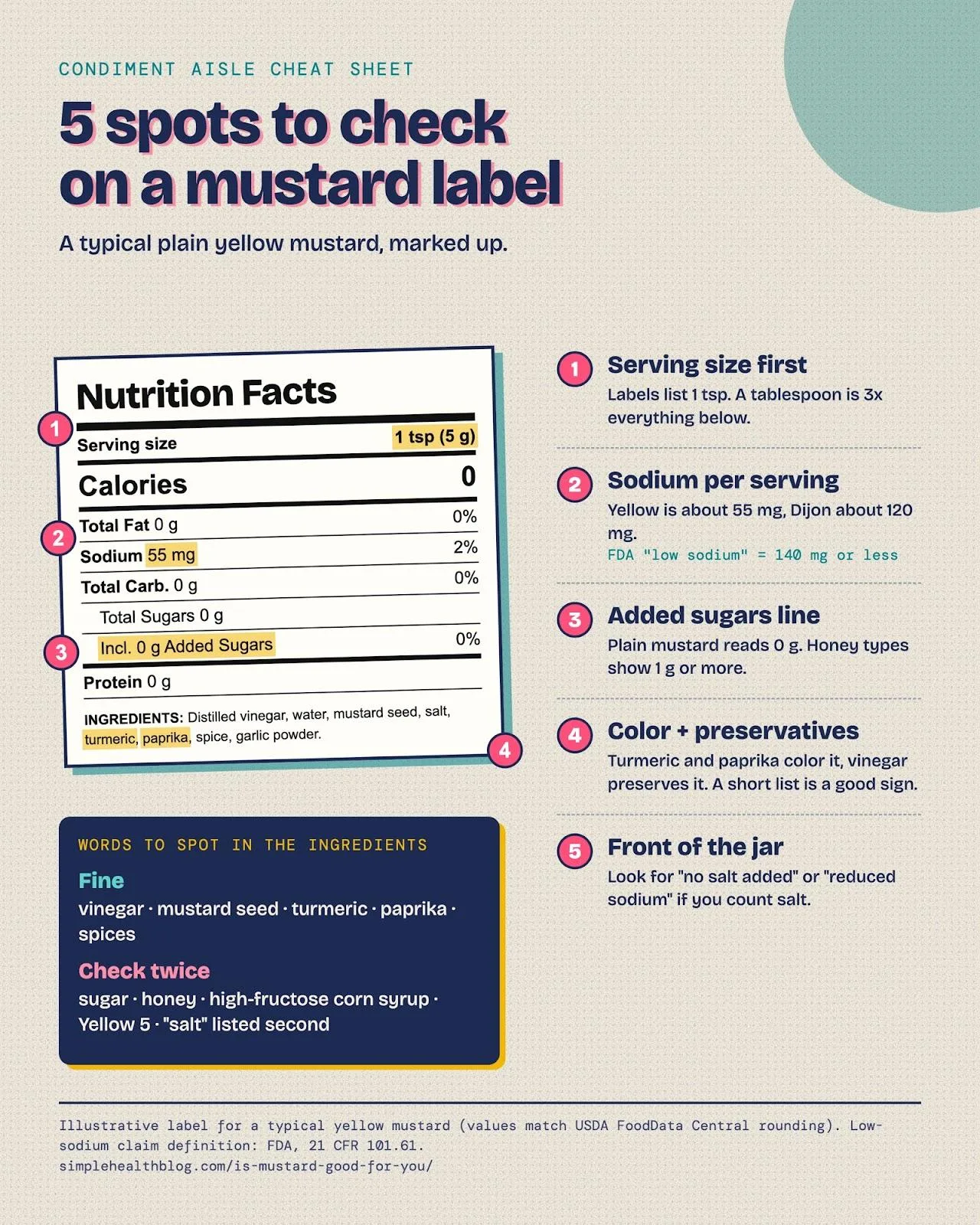
Use this 5-point check in the condiment aisle:
- Sodium per serving: Most yellow and spicy brown mustards land around 40 to 60 mg per teaspoon, and Dijon around 120 mg. Anything above that is on the salty side.
- Added sugar: Look for sugar, honey or high-fructose corn syrup. Plain mustards don’t need any.
- Artificial dyes: Most yellow mustards use turmeric, so synthetic dyes are easy to skip.
- Preservatives: Vinegar does most of the preserving, so a short ingredient list is a good sign.
- Low-sodium options: Many stores carry no-salt-added or reduced-sodium versions.
You can look up a specific jar’s ingredients and nutrition concerns in the EWG Food Scores database.
Is Mustard Better for You Than Mayo or Ketchup?
Yes. One tablespoon of yellow mustard has about 9 calories, while regular mayo has about 94, and mustard has almost no sugar compared with ketchup’s 3.6 g per tablespoon.
| Condiment (1 tbsp) | Calories | Fat | Sugar | Sodium |
|---|---|---|---|---|
| Yellow mustard | 9 | 0.5 g | 0.1 g | 165 mg |
| Mayo, regular | 94 | 10.3 g | 0.1 g | 88 mg |
| Mayo, light | 36 | 3.3 g | 0.5 g | 124 mg |
| Ketchup | 17 | 0 g | 3.6 g | 154 mg |
| Honey mustard | about 30 | 0 g | about 3 g | about 150 mg |
| BBQ sauce | 29 | 0.1 g | 5.6 g | 175 mg |
| Ranch dressing | 65 | 6.7 g | 0.7 g | 135 mg |
Source: USDA FoodData Central (SR Legacy). Honey mustard is a typical squeeze-bottle label value.
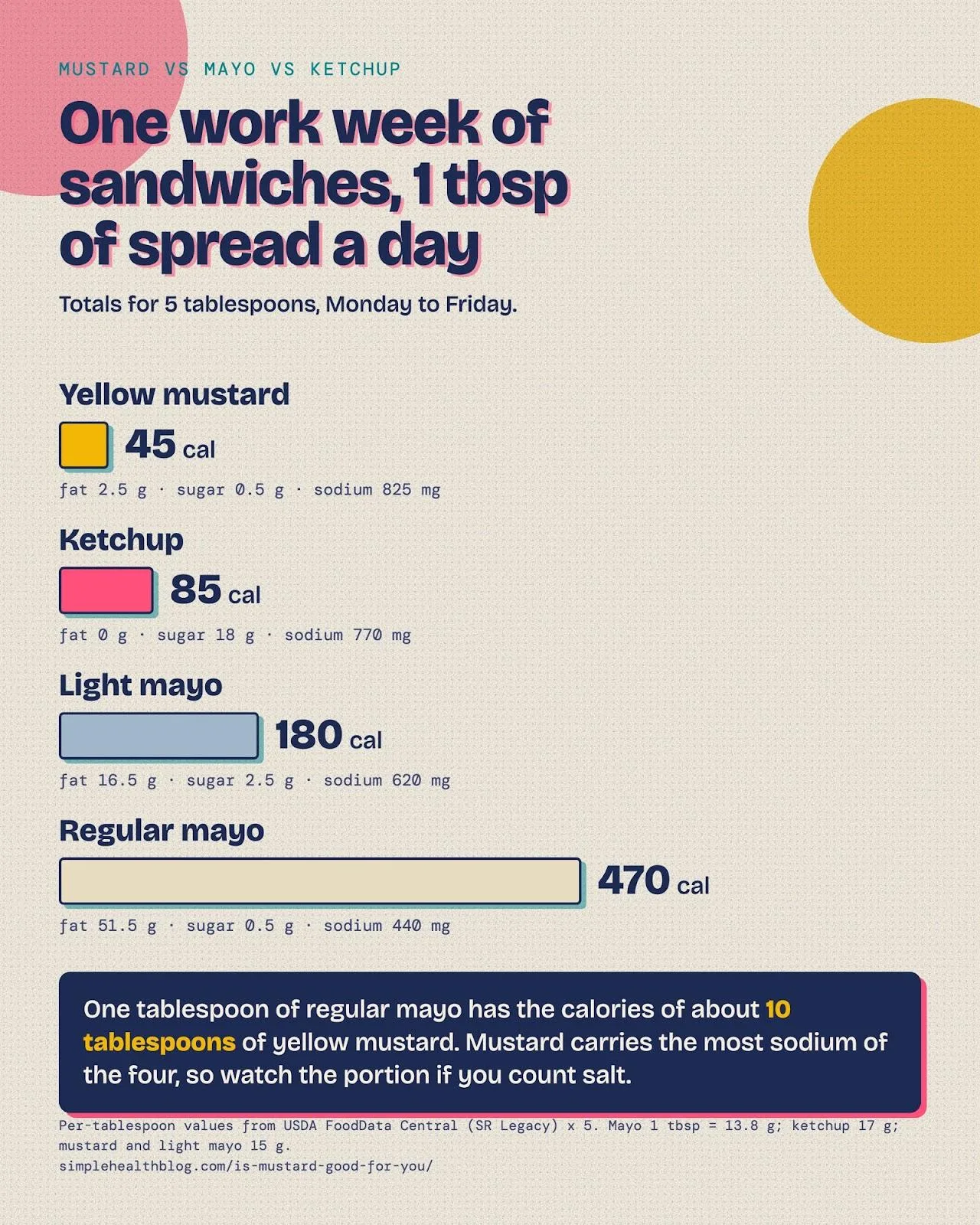
If you watch salt, notice that mustard has more sodium per tablespoon than mayo. It still wins on calories, fat, and sugar.
Can You Replace Mayo With Mustard?
Often, yes. Mustard works well in sandwiches, wraps, deviled eggs, egg salad, and vinaigrettes, where you want tang more than richness.
It can’t copy mayo’s creamy texture in coleslaw or potato salad. There, try the half-and-half trick: mix equal parts mustard and mayo (or Greek yogurt) to keep the creaminess and cut calories.
Egg salad is the easiest place to start: swap most of the mayo for Dijon and yogurt, and you keep the protein perks of eggs for weight loss without the extra fat.
Does a Spoonful of Mustard Help With Cramps?
Many people swear by it, but no clinical trial has tested mustard for cramps directly. If it helps, it’s likely a reflex triggered by the sharp taste, not the nutrients in it.
What the Research Says
The closest evidence comes from pickle juice. In a 2010 study in Medicine & Science in Sports & Exercise (human lab study), researchers triggered foot cramps in mildly dehydrated men with electrical stimulation. After a small sip of pickle juice, cramps lasted about 85 seconds, compared with about 134 seconds after water. That’s roughly 49 seconds shorter.
Blood electrolytes barely moved, so the researchers suspect a nerve reflex that starts in the mouth and throat.
The popular “it’s the potassium” or “it’s the turmeric” theory doesn’t hold up, since a teaspoon has only about 8 mg of potassium. In a 2014 study in the Journal of Athletic Training, nine people ate around 135 g of mustard after hard exercise, and their blood sodium and potassium didn’t change within an hour.
How Much and How Fast People Say It Works
Most people use a teaspoon or a single fast-food packet the moment a cramp starts, and the reports are surprisingly consistent. Readers of The People’s Pharmacy describe a packet easing a night-time leg cramp almost right away, and one long-distance cyclist there carries packets on every ride.
Greg Conderacci wrote on Road Bike Rider that one packet ended severe cramps in both legs on a hilly 200 km ride, though he’s clear it’s no miracle cure. Members of the Cyclone Fanatic fan forum share similar stories, like being handed a packet mid half-marathon.
This is personal experience, not proof. Frequent cramps are worth mentioning to your doctor.
Why Do Bodybuilders Eat Mustard?
Mostly because it flavors plain chicken, eggs and rice for almost zero calories, which helps during strict diet phases. Some also keep packets for cramps, based on the same anecdotes and pickle juice research above.
Downsides of Mustard: When to Be Careful
For most people, the only real downsides are sodium and the sugar in sweet mustards.
- Sodium: About 165 mg per tablespoon of yellow mustard, more in Dijon and English. Worth counting on a low-sodium diet.
- Added sugar: Honey mustards add about 1 g per teaspoon, which creeps up when you use them as a dip.
- Mustard allergy: Mustard is a priority allergen that must be labeled in Canada and the EU. In the US, it’s not one of the FDA’s nine major allergens, so it can appear under “spices” on some labels.
- Goitrogens: Raw mustard seeds and greens contain compounds that, in very large amounts, may affect thyroid function, according to Oregon State’s Linus Pauling Institute. It’s only relevant for people with thyroid conditions who eat a lot of them.
- Stomach upset or heartburn: Large amounts, or hot types like English mustard, can irritate a sensitive stomach.
Who should check with a doctor first
- People on a low-sodium or kidney diet
- People with thyroid conditions who eat a lot of mustard greens or seeds
- Anyone with a known or suspected mustard allergy
How Much Mustard Is OK a Day?
There’s no official limit on mustard. For most people, 1 to 2 tablespoons a day is fine, and sodium is the thing to keep an eye on.
The math is simple. The 2025 to 2030 Dietary Guidelines for Americans, released in January 2026, keep the advice to stay under 2,300 mg of sodium a day. Two tablespoons of yellow mustard add about 330 mg, around 14% of that limit. With Dijon, it’s closer to 700 mg.
Is it OK every day? Yes, for most people. “It is considered safe to consume mustard daily,” Lon Ben-Asher, MS, RD, a dietitian at Pritikin Longevity Center, told USA Today in October 2023. He suggests a low-sodium version if salt is a concern.
If you have kidney disease, ask your care team how mustard fits your sodium budget.
Easy Ways to Use Mustard in Healthy Meals
Use it to replace higher-calorie sauces. Here are five easy ways to start:
- Vinaigrette base: Whisk 1 tsp Dijon with 1 tbsp vinegar and 1 tbsp olive oil.
- Chicken or fish marinade: Coat chicken thighs or salmon with mustard, garlic and lemon before baking.
- Lighter egg salad: Use Dijon and Greek yogurt in place of most of the mayo.
- Sandwich spread: Whole-grain mustard adds texture and bite for a few calories.
- Glaze for roasted vegetables: Toss carrots or Brussels sprouts with mustard and a drizzle of maple syrup before roasting.
Frequently Asked Questions
Is mustard bad for your liver?
Normal amounts of mustard aren’t linked to liver harm. The liver studies you may see used concentrated mustard plant extracts in animals, like a 2023 animal study on a high-fat diet. Those results don’t tell us what a teaspoon does in people.
Is mustard good for your stomach?
Mustard is fine for most stomachs in normal amounts. Very spicy types, like English mustard, can trigger heartburn in people prone to reflux, so milder yellow mustard is the safer pick.
Is Dijon mustard just mustard and mayonnaise?
No. Dijon is a mustard made from brown or black mustard seeds with white wine or verjuice (sour grape juice) instead of plain vinegar. The creamy blend of Dijon and mayo is sold as Dijonnaise-style spread, which has more calories.
Does a teaspoon of mustard lower blood pressure?
There’s no evidence that mustard lowers blood pressure. It actually contains sodium, about 55 mg per teaspoon of yellow mustard, so if you’re managing blood pressure, count it toward your daily sodium and choose a low-sodium version.
Can mustard lower cholesterol?
There’s no good evidence that eating mustard lowers cholesterol in people. A few animal studies have tested mustard seed or greens, but no human trial has tested the condiment. Using it in place of mayo does trim saturated fat.
Is mustard oil the same as mustard?
No. Mustard oil is pressed from mustard seeds and is a different product. In the US, the FDA’s Import Alert 26-04 restricts expressed mustard oil as a cooking oil because of its high erucic acid content, so it’s often sold for external use.
Is French’s yellow mustard healthy?
French’s Classic Yellow Mustard is a fine everyday pick. Its label lists 0 calories and about 55 mg of sodium per teaspoon, with no sugar. Its color comes from turmeric and paprika. Like any mustard, keep an eye on portions if you watch sodium.
Conclusion
Mustard is one of the easiest healthy swaps in your kitchen: big flavor, almost no calories and no sugar in the plain kinds. Pick plain yellow or Dijon, check the sodium, and use it in place of creamier sauces.
Everything here is general information, and the site’s medical disclaimer explains why it can’t replace advice from your doctor or a registered dietitian.
Sources
- USDA FoodData Central: Mustard, prepared, yellow
- Dietary Guidelines for Americans 2025 to 2030
- Henry CJ, Emery B. Effect of spiced food on metabolic rate. Hum Nutr Clin Nutr, 1986
- Gregersen NT et al. Acute effects of mustard, horseradish, black pepper and ginger on energy expenditure. Br J Nutr, 2013
- Miller KC et al. Reflex inhibition of electrically induced muscle cramps in hypohydrated humans. Med Sci Sports Exerc, 2010
- Miller KC. Electrolyte and plasma responses after pickle juice, mustard, and deionized water ingestion. J Athl Train, 2014
- Anticancer activity, mechanism, and delivery of allyl isothiocyanate. Bioengineering, 2022
- Costa-Pérez A et al. Systematic review on the metabolic interest of glucosinolates. Nutrients, 2023
- Lin CM et al. Antibacterial mechanism of allyl isothiocyanate. J Food Prot, 2000
- EWG Food Scores
How we research and review our articles: see our editorial policy.
