


Share This Article
The same handful of kernels can turn into one of the lightest snacks in your kitchen or one of the heaviest. Popcorn is a whole grain, and plain air-popped popcorn has about 31 calories a cup, so is popcorn healthy for weight loss? It can be a smart, filling pick, as long as butter, oil, sugar and giant bowls stay in check. The kernel is rarely the problem. What you pour on it and how much you eat usually decide whether it helps or stalls you.
No single food causes weight loss on its own, popcorn included. What it can do is give you a big, crunchy snack for few calories. This guide covers calories by type, why popcorn may keep you full, what ruins it, and how much to eat.
Quick answer: Yes, plain air-popped popcorn can fit a weight-loss diet. One cup has about 31 calories and 1.2 g of fiber, and it is a whole grain. Butter, oil, caramel and large portions add calories quickly, so the way you make it decides most of the result.
Every nutrition number in this Simple Health Blog guide comes from USDA FoodData Central (confirmed in November 2026), and the study details come from the original papers.
Is Popcorn Healthy for Weight Loss? The Short Answer
Yes, popcorn is healthy for weight loss when it’s air-popped or made with a little oil, and when you portion it out. Three things work in its favor:
- Low energy density: Popped corn is mostly air, so a full bowl has few calories.
- Fiber: A 3-cup serving gives you about 3.5 g of fiber, which helps you feel full.
- Whole grain: Every popped kernel is a whole grain, with the bran and germ still on.
The catch is toppings and portions. A tablespoon of butter can double the calories in a bowl, and “volume snacks” are easy to overeat straight from a big bowl. Popcorn works best as one swap inside a wider diet and weight loss plan, alongside your meals, sleep and activity.
How Many Calories Are in Popcorn?
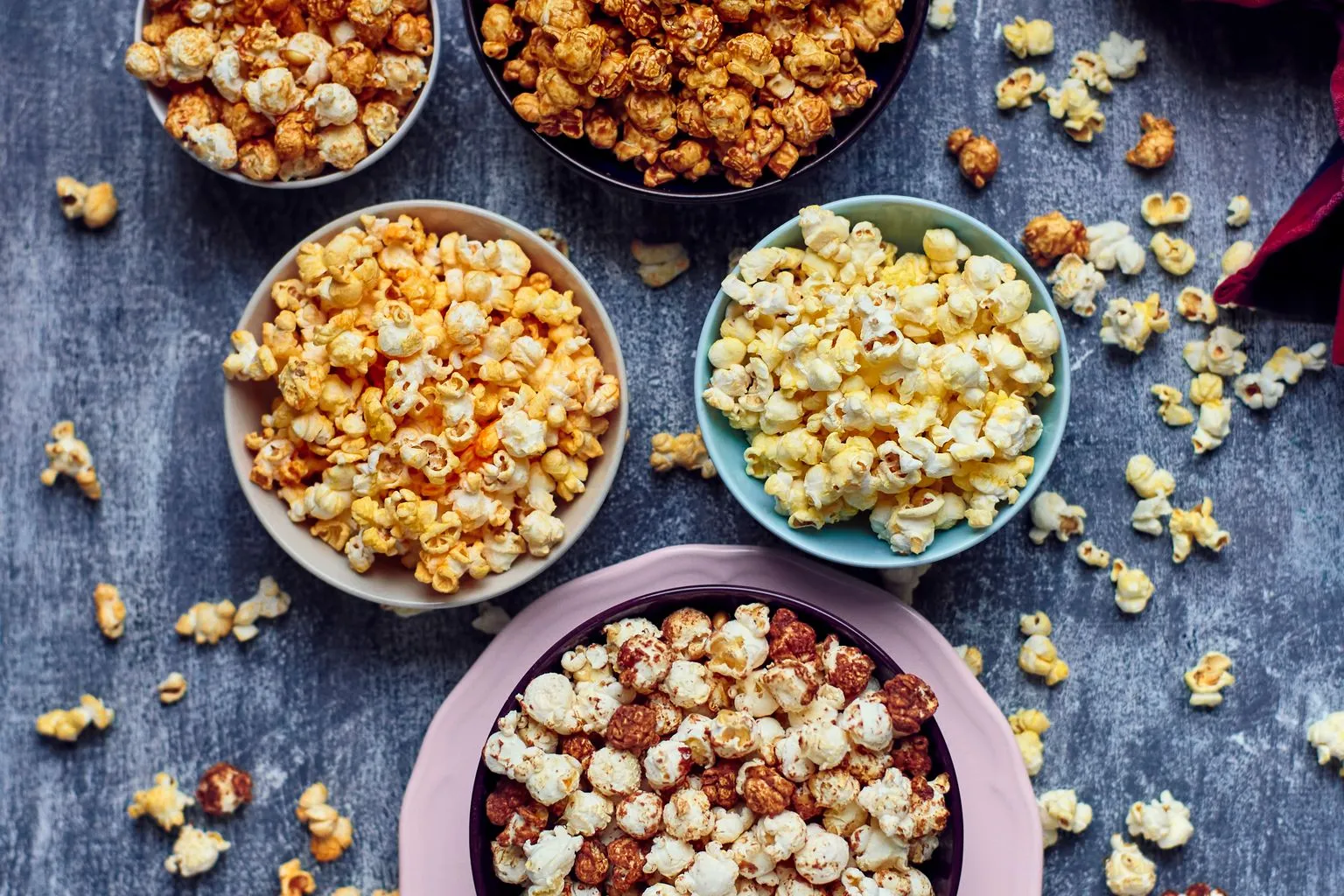
Air-popped popcorn has about 31 calories per cup, or 93 calories in a 3-cup serving. The number climbs fast once oil, butter flavoring or caramel gets involved. Here’s how the main types compare for the same weight:
| Popcorn type (USDA FDC ID) | Calories (kcal) | Fat (g) | Fiber (g) | Sugar (g) | Sodium (mg) |
|---|---|---|---|---|---|
| Air-popped, plain (167959) | 110 | 1.3 | 4.1 | 0.2 | 2 |
| Oil-popped, salted (170247) | 142 | 8.0 | 2.8 | Not listed | 251 |
| Microwave, butter flavor, palm oil (173141) | 152 | 8.6 | 2.8 | 0.1 | 216 |
| Caramel-coated, no peanuts (167552) | 122 | 3.6 | 1.5 | 15.1 | 58 |
Per 1 oz (28 g). Source: USDA FoodData Central, SR Legacy, per-100 g values converted to 1 oz.
One ounce of air-popped popcorn is about 3.5 cups, which is a big bowl. The same ounce of oil-popped or caramel corn looks much smaller, because oil and sugar add weight without adding volume. So when you compare popcorn by the cup, the difference between types is even bigger than this table shows.
For a single cup of plain air-popped popcorn, USDA lists:
- Calories: 31
- Fiber: 1.2 g
- Protein: 1 g
- Carbs: 6.2 g
A 3-cup serving triples those numbers: about 93 calories, 3.5 g of fiber and 3 g of protein.
Why Can Popcorn Help You Feel Full?
Popcorn can help you feel full because it’s bulky and fibrous, so a portion takes up a lot of room for few calories. Your eyes and your stomach both register a big bowl, even though the calorie count stays small.
Fiber and Volume
A 3-cup serving of air-popped popcorn gives you about 3.5 g of fiber. That’s roughly 12% of the 28 g Daily Value for fiber the FDA uses on food labels. MedlinePlus, the National Library of Medicine’s health site, says “dietary fiber makes you feel full faster, helping you control your weight.”
Volume does the rest. “Energy density” is a simple idea: how many calories a food packs into each bite. Popcorn puffs up when it pops, so each cup is mostly air with a thin shell of grain. You get lots of chewing and crunch for very few calories.
Other high-fiber snacks follow the same logic. Chia pudding is one to rotate in, and knowing how long to soak chia seeds gets the texture right.
What the Popcorn vs Potato Chips Study Found
A 2012 trial suggests popcorn may be more filling than potato chips, at least in the short term. In that 2012 study in Nutrition Journal, 35 normal-weight adults aged 20 to 50 ate a snack 30 minutes before an all-you-want lunch of macaroni and cheese. Each person tried every option on separate days.
After 6 cups of low-fat microwave popcorn (100 calories), people rated themselves less hungry and more satisfied than after 1 cup of potato chips (150 calories). Adding the snack and lunch together, they ate about 739 calories on the popcorn day and 803 calories on the chips day.
Keep the limits in mind before you treat this as proof:
- It was small and short, with one snack before one meal each time.
- Everyone was a normal-weight adult under 50, so results may differ for people with obesity, older adults and kids.
- The portions weren’t matched for calories, and people could see how big each snack was.
- The popcorn was a 94% fat-free microwave type, and ConAgra Foods, a popcorn maker, funded the study.
Is Popcorn a Whole Grain?
Yes, popcorn is a whole grain, because each popped kernel keeps its bran, germ and starchy center. USDA’s MyPlate grains guidance places popcorn in the Grains Group, and USDA’s Agricultural Research Service calls it a 100 percent whole grain, noting that one serving provides “about one-third of the whole grains most American adolescents and adults need.”
People who eat popcorn also tend to eat more whole grains overall. A study of NHANES 1999 to 2002 survey data found popcorn eaters averaged 2.5 servings of whole grains a day, against 0.70 for non-eaters, and about 18.1 g of fiber a day versus 14.9 g. The study was observational, so it shows a link and can’t prove popcorn caused the difference. One of its authors also worked for ConAgra Foods.
Whole grains are one of the simplest nutrition upgrades you can make, and popcorn is the snack version.
When Is Popcorn Not Healthy for Weight Loss?
Popcorn stops being healthy for weight loss when butter, oil, sugar or big portions turn a light snack into a heavy one. The kernel stays the same; everything added to it changes the math.
Butter and Oil
Fat adds calories fastest. One tablespoon of salted butter (FDC 173410) has about 102 calories, and one tablespoon of olive oil (FDC 171413) has about 119. Melt a tablespoon of butter over a 3-cup bowl and the snack goes from about 93 calories to about 195, more than double. Two tablespoons push it near 300.
Caramel, Kettle and Sweet Popcorn
Sweet popcorn swaps the fiber advantage for sugar. Caramel corn has about 15 g of sugar per ounce and about a third of the fiber of plain air-popped popcorn. Kettle corn is popped with oil and sugar together, so check its label for added sugar and serving size. Treat both as dessert.
Movie Theater Popcorn
Movie theater popcorn is where portions get out of hand. AMC Theatres’ current nutrition guide lists its large plain popcorn with no butter (150 fl oz) at 870 calories, about nine times a 3-cup bowl at home. The “butter topping” is a flavored oil pumped on top, which adds fat calories the same way the butter above does. Large US restaurant chains have had to post calories on menus since May 2018 under FDA rules, so check the board or the chain’s nutrition page before you order. A small, plain size is the lighter pick.
Some regular moviegoers have noticed this too. One r/RegalUnlimited thread on how people order their popcorn had a top reply from someone who became “a staunch no butter person” after seeing the calorie breakdown for the topping.
Is Microwave Popcorn Healthy?
Microwave popcorn can be healthy, but you need to read the label for fat, sodium and serving size. The butter-flavor type in the table above has about 152 calories, 8.6 g of fat and 216 mg of sodium per ounce, compared with 110 calories, 1.3 g of fat and 2 mg of sodium for air-popped. Members of r/loseit put it bluntly in a long-running thread: skip the pre-buttered bags, which can double the calories.
The bag itself is less of a worry than it used to be. In February 2024, the FDA announced that PFAS grease-proofers, “forever chemicals” once used in paper food packaging such as microwave popcorn bags, are no longer sold into the US market for food contact.
USDA’s Agricultural Research Service gives a simple rule for packaged popcorn: “Glance at the ingredients list and nutrition facts to make sure the amounts of sodium and saturated fat are low.” Use this 3-point check:
- Serving size: Compare the popped cups per serving with what you’ll really eat. Many bags contain more than one serving.
- Fat and saturated fat: Lower is better. “Light” or plain types usually have far less.
- Sodium: Aim for the lower end. Salted types can pass 200 mg per ounce.
Popcorn vs Other Snacks: Which Is Better for Weight Loss?
Per ounce, air-popped popcorn has the most fiber of common salty snacks and almost the least fat, which makes it the better pick for weight loss in most cases. Here’s the side-by-side:
| Snack (USDA FDC ID) | Calories (kcal) | Fat (g) | Fiber (g) | Sodium (mg) |
|---|---|---|---|---|
| Popcorn, air-popped (167959) | 110 | 1.3 | 4.1 | 2 |
| Potato chips, plain, salted (169677) | 151 | 9.6 | 0.9 | 149 |
| Pretzels, hard, plain, salted (167555) | 109 | 0.8 | 1.0 | 352 |
| Tortilla chips, yellow, plain, salted (173143) | 141 | 6.3 | 1.3 | 88 |
Per 1 oz (28 g). Source: USDA FoodData Central, SR Legacy, confirmed in November 2026.
Pretzels match popcorn on calories, but they have about a quarter of the fiber and roughly 175 times the sodium. Potato chips have the most fat by far.
The bigger difference shows up in the bowl. A popular r/Volumeeating post weighed it out: 100 calories of regular chips came to about 18 g, around 10 chips, while 100 calories of air-popped popcorn was about 30 g, almost 4 cups. That’s the volume advantage you can see.
How Much Popcorn Can You Eat on a Diet?
About 3 cups of air-popped popcorn, or around 93 calories, is a common snack portion. There’s no fixed daily limit. What counts is how popcorn fits into your total calories for the day.
Volume snacks are easy to overdo. One r/loseit member found their stalled weight loss picked up again after cutting their nightly popcorn portion in half. In r/Volumeeating, another member admitted to eating 500 calories of popcorn a night, and warned others that a “good volume snack” still needs measuring.
These habits make portions easier:
- Pre-portion it: Measure 3 cups into a bowl and put the rest away.
- Skip the bag: Eating straight from a big bag or tub makes it hard to notice how much you’ve had.
- Count the extras: A drizzle of oil or a sprinkle of cheese adds up, so track it along with the popcorn.
- Use a scale if you track: Weighing your portion once or twice shows you what 3 cups really looks like.
Activity counts toward the same daily total. If you track movement as well as snacks, knowing how many steps is a 30 minute walk gives you an easy daily target to pair with a measured bowl.
How to Make Popcorn Healthy for Weight Loss

Air-pop it or use a small, measured amount of oil, then season it with low-calorie flavors. Those two steps keep the snack close to its plain, air-popped calorie count.
Air-Pop at Home
An air popper uses hot air only, so you add zero fat. On the stovetop, 1 to 2 teaspoons of oil is enough for a batch, adding about 40 calories per teaspoon. Skip popping kernels in a brown paper bag in the microwave: USDA’s Food Safety and Inspection Service lists brown paper bags among materials that aren’t approved for microwave cooking.
Low-Calorie Toppings
Plain popcorn takes flavor well, so you can skip the butter without eating something bland. Try these:
- Cinnamon: Sweet flavor with no sugar added.
- Chili powder or smoked paprika: Warm and savory. One r/Volumeeating member named chili powder their go-to late-night popcorn upgrade.
- Nutritional yeast: A cheesy, nutty taste.
- Garlic powder: Pairs well with a pinch of salt.
- Light olive-oil spray: Helps the spices stick with very little fat.
- A little grated parmesan: Measure a tablespoon so it doesn’t creep up.
To make the snack more filling, pair your bowl with protein, such as a hard-boiled egg or plain Greek yogurt. Protein adds staying power, and it’s one big reason eggs are good for weight loss snacks too.
Who Should Be Careful With Popcorn?
Most adults can eat plain popcorn, but some people should take care:
- Young children: The American Academy of Pediatrics lists popcorn among the foods to avoid for young kids because of choking risk, and its advice is to wait on higher-risk foods until about age 4.
- People watching sodium: Salted, oil-popped and microwave types carry about 215 to 250 mg of sodium per ounce.
- People with diabetes: Popcorn’s carbs (about 6 g per cup) still count toward your meal plan.
- Dental work or eating conditions: Hard hulls and unpopped kernels can be a problem with braces, crowns or trouble swallowing.
If you have a health condition or take medication, talk to your doctor or a registered dietitian about how popcorn fits your diet. This guide is general information and comes with a medical disclaimer.
Frequently Asked Questions
Is Popcorn Good for Losing Belly Fat?
No food burns fat from one body part, including belly fat. Popcorn may help as a low-calorie, filling swap for heavier snacks. Losing belly fat happens as part of losing fat overall, which depends on an overall calorie deficit over time, plus activity and sleep.
Can I Eat Popcorn Every Day and Still Lose Weight?
Yes, you can eat popcorn every day and still lose weight if you count the portion and toppings in your daily calories. A 3-cup bowl of air-popped popcorn is about 93 calories. Mix in other snacks, such as fruit or yogurt, so you get a wider range of nutrients.
What Is Better to Eat, Popcorn or Potato Chips?
For weight loss, air-popped popcorn is usually the better pick. Per ounce, USDA FoodData Central lists 110 calories, 1.3 g of fat and 4.1 g of fiber, against 151 calories, 9.6 g of fat and 0.9 g of fiber for plain potato chips. A 2012 study also found popcorn more filling.
Can I Eat Popcorn Without Gaining Weight?
Yes. Popcorn on its own doesn’t cause weight gain; eating more calories than you burn over time does. Plain air-popped popcorn is about 31 calories a cup. Butter, caramel and large movie theater tubs are what make the calories add up, so keep those occasional and portion the rest.
Is Popcorn OK to Eat at Night?
Yes, popcorn is fine at night. How much you eat across the whole day counts for more than the time on the clock. A small bowl of plain air-popped popcorn is a lighter late-night choice than chips, cookies or ice cream, as long as you portion it and go easy on butter.
Is Popcorn High in Carbs?
Popcorn is moderate in carbs. One cup of air-popped popcorn has about 6.2 g of carbs, and 1.2 g of that is fiber, according to USDA data. A 3-cup serving has about 19 g of carbs. If you follow a low-carb plan, measure your portion and count it.
Is SkinnyPop or Bagged Popcorn Healthy?
Bagged, ready-to-eat popcorn can be a reasonable snack, but brands vary a lot. Compare the Nutrition Facts label on any bag you’re considering: calories, fat, sodium and serving size in cups. Pick one with a short ingredient list and low sodium, and portion it into a bowl.
Conclusion
Popcorn can be a smart, filling, whole-grain snack for weight loss, and the deciding factors of whether it’s healthy or not are how you make it and how much you eat. Plain and air-popped, it gives you a big bowl for very few calories. Buttered, caramel-coated or tub-sized, it behaves like any other heavy treat.
Try this swap this week: replace your usual evening chips with a measured 3-cup bowl of air-popped popcorn and a spice you like. Food is one half of the plan, and if you want to add movement, rucking for weight loss adds extra calorie burn to an ordinary walk.
How we research and review our articles: see our editorial policy.
