

Share This Article
Disclaimer: This blog is for general information only and is not medical advice.
For most adults, a 30 minute walk adds up to somewhere between 2,100 and 4,000 steps, and about 3,000 is a good middle number for a steady, moderate pace. How many steps a 30 minute walk gives you depends mostly on speed. An easy stroll lands near the bottom of that range, while a fast walk with pumping arms pushes you toward 4,000.
Your height and stride play a part too. Taller people cover more ground with each step, so they log fewer steps in the same half hour. Below you’ll find step counts by pace and by height, how far you’ll travel, what a 30 minute walk does for your weekly activity goal, and an easy way to work out your own number.
How many steps is a 30 minute walk at different paces?
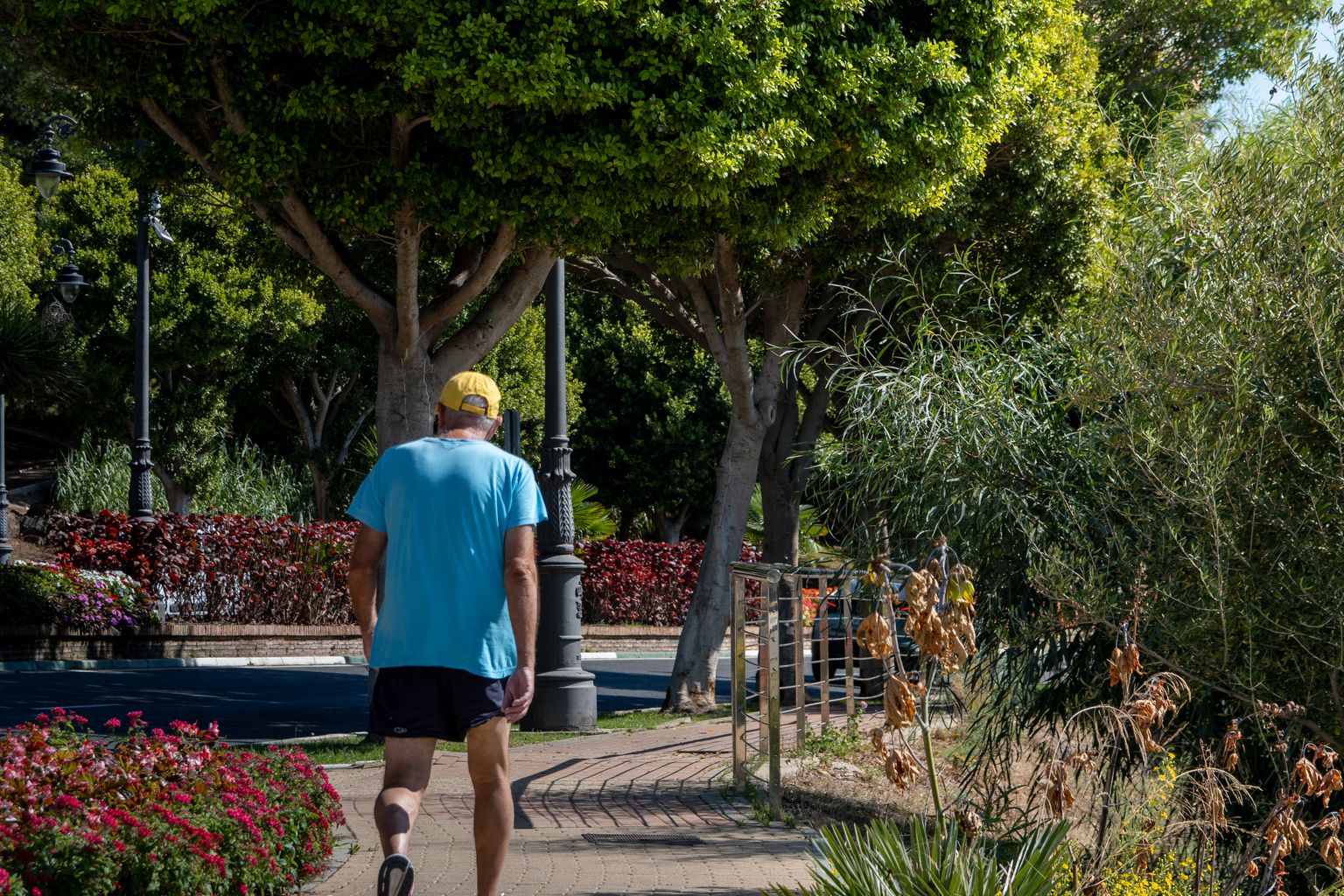
A 30 minute walk is roughly 2,100 to 2,700 steps at an easy pace, 2,700 to 3,150 at a moderate pace, 3,150 to 3,600 at a brisk pace, and 3,600 to 4,000 if you walk fast. The quickest way to estimate it yourself is to multiply your steps per minute by 30.
| Pace | Approx. speed | Steps per minute | Steps in 30 minutes | Distance in 30 minutes |
|---|---|---|---|---|
| Easy stroll | about 2 mph | 70 to 90 | 2,100 to 2,700 | about 1 mile |
| Moderate | 2.5 to 3 mph | 90 to 105 | 2,700 to 3,150 | 1.25 to 1.5 miles |
| Brisk | 3 to 3.5 mph | 105 to 120 | 3,150 to 3,600 | 1.5 to 1.75 miles |
| Fast | 3.5 to 4 mph | 120 to 135 | 3,600 to 4,050 | 1.75 to 2 miles |
These are averages for an adult of average height on flat ground. Treat them as a starting point, not a target you have to hit exactly.
What counts as an easy pace?
An easy pace is the speed you’d use window shopping or walking a dog that stops at every lamppost. You can chat and breathe through your nose without effort. Most people land around 70 to 90 steps a minute here.
What counts as a brisk pace?
A brisk pace feels purposeful. You can still talk in full sentences, but you couldn’t sing, and you’ll notice your breathing pick up after a few minutes. The CDC lists walking briskly at 2.5 miles per hour or faster as a moderate intensity activity, which is the kind that counts toward weekly exercise goals.
How many steps per minute is a brisk walk?
About 100 steps per minute is the point where walking becomes moderate exercise for most adults. Researchers in the CADENCE-Adults study measured people walking on treadmills and found that 100 steps per minute lined up with moderate intensity and 130 steps per minute with vigorous intensity. Follow-up studies found the same 100 and 130 cutoffs held for adults in their 40s and 50s, and the 100 mark held for adults aged 61 to 85.
That is where the popular “3,000 steps in 30 minutes” goal comes from. A 2009 study in the American Journal of Preventive Medicine translated the moderate exercise guideline into a pedometer target: walk at 100 steps a minute or faster, which gives you 1,000 steps in 10 minutes and 3,000 in 30.
So if your 30 minute walk lands near 3,000 steps or more, you’re very likely walking at a moderate pace. If you’re closer to 2,200, you’re strolling. Both are fine, but only one usually counts as exercise in the guideline sense.
How does your height change your steps in 30 minutes?
Taller people take longer steps, so they need fewer of them to cover the same distance. At the same walking speed, a 6 foot person might log 500 or more fewer steps in 30 minutes than someone who is 5 feet tall.
A common rule of thumb puts step length at around 41% of your height. It’s a rough estimate, and your step gets longer as you speed up, but it gives you a useful ballpark:
| Height | Approx. step length | Steps per mile | Steps in 30 min at 3 mph |
|---|---|---|---|
| 5’0″ (152 cm) | about 2 ft | about 2,550 | about 3,850 |
| 5’4″ (163 cm) | about 2.2 ft | about 2,400 | about 3,600 |
| 5’8″ (173 cm) | about 2.3 ft | about 2,250 | about 3,400 |
| 6’0″ (183 cm) | about 2.5 ft | about 2,150 | about 3,200 |
Leg length matters more than height itself, and so does how you walk. Someone who takes quick, short steps will rack up more than someone of the same height with a long, loping stride. That’s why the most accurate answer to how many steps is a 30 minute walk for you is the one you measure on your own walk.
How far do you walk in 30 minutes?
Most people walk between 1 and 2 miles in 30 minutes. At an average pace of about 3 miles per hour, that’s 1.5 miles, or roughly 2.4 kilometers. Research on preferred walking speed puts most people’s natural pace between about 2.5 and 3.7 mph, so 3 mph sits right in the middle.
Here’s a quick way to think about it. At 3 mph, each mile takes 20 minutes. At 4 mph, a mile takes 15 minutes, so a half hour gets you to 2 miles. Hills and traffic lights pull the distance down, even if your step count stays similar.
How many calories does a 30 minute walk burn?
A 30 minute walk at 3.5 mph burns roughly 107 calories for a 125 pound person, 133 calories for someone who weighs 155 pounds, and 159 calories at 185 pounds, according to Harvard Health Publishing’s calorie table. Heavier bodies use more energy to move, and faster walking burns more than slow walking.
These are estimates. Fitness watches give their own numbers, and they often disagree with each other. If weight loss is part of your goal, walking helps, but what you eat usually matters more. Our article on whether eggs are good for weight loss covers the food side of that equation.
Is a 30 minute walk a day enough?
For general health, a brisk 30 minute walk on 5 days a week meets the main exercise guideline. The CDC recommends that adults get at least 150 minutes of moderate intensity activity each week, plus muscle strengthening activity on 2 days. Five brisk half hours cover the 150 minutes.
Daily step totals tell a similar story. A 2022 analysis of 15 studies, led by researcher Amanda Paluch and published in The Lancet Public Health, found that more daily steps were linked to a lower risk of early death, with the benefit leveling off at about 6,000 to 8,000 steps a day for adults over 60 and 8,000 to 10,000 for younger adults. A 30 minute walk at a moderate pace covers a big share of that, and the rest comes from normal daily movement.
A daily walk has other perks people tend to notice first. A short walk after meals may ease that heavy, bloated feeling, which we look at in our guide on whether walking helps digestion. Regular daytime activity is also one of the habits linked to better rest, something we cover in how to get more deep sleep.
How can you count your own steps in 30 minutes?

The simplest way to find out how many steps is a 30 minute walk for you is to count your steps for one minute at your usual pace and multiply by 30. If you count 104 steps in a minute, your 30 minute walk is about 3,100 steps.
Three easy methods
- Count for one minute. Walk at your normal pace, start a timer, count every time either foot lands, then multiply by 30. Do it twice and average the results.
- Use a tracker or phone. Wear it for a full 30 minute walk and note the total. Most phones and watches count steps well on a steady walk, and less well when you push a stroller or a shopping cart, because your arm stops swinging.
- Use a known distance. Walk a measured route, like a 400 meter track lap, and count your steps. Divide the distance by the steps to get your step length.
How to check your tracker is accurate
Walk exactly 100 steps, counting in your head, then look at your device. If it reads between 95 and 105, it’s close enough. If it’s far off, check that it’s worn snugly on your wrist and that your height is set correctly in the app, since many trackers use height to estimate stride.
How do you get more steps in a 30 minute walk?
Speed up your cadence rather than stretching your stride. Taking quicker, shorter steps adds steps per minute without straining your hips or shins. A few other changes help:
- Swing your arms. Bent arms moving front to back naturally speed up your legs.
- Add intervals. Try 2 minutes fast, 1 minute easy, and repeat through the walk.
- Use music with a beat. A playlist around 100 to 120 beats per minute makes it easy to match your steps to the rhythm.
- Pick a flatter route when you want a high step count, and save hills for days you want more effort.
If you’re new to walking or returning after a break, there’s no need to chase 4,000 steps on day one. Build from a comfortable pace and let the number climb over a few weeks.
Frequently Asked Questions
Is 3,000 steps in 30 minutes good?
Yes. 3,000 steps in 30 minutes means you averaged 100 steps a minute, which research links to moderate intensity walking for most adults. That’s the pace that counts toward weekly exercise guidelines.
How many steps is a 30 minute brisk walk?
A 30 minute brisk walk is usually about 3,150 to 3,600 steps, based on a cadence of roughly 105 to 120 steps a minute. Shorter people and fast walkers can go higher.
How many steps is a 30 minute walk on a treadmill?
About the same as outdoors at the same speed. At 3 mph on a flat treadmill, most adults take roughly 3,000 to 3,500 steps in 30 minutes. Holding the handrails can stop wrist trackers from counting properly.
How many miles is 30 minutes of walking?
Usually 1 to 2 miles. At an average pace of 3 mph, you’ll cover about 1.5 miles, or around 2.4 kilometers.
How many steps is a 20 minute walk?
Around 1,400 to 2,700 steps, depending on pace. At a moderate 100 steps a minute, a 20 minute walk is about 2,000 steps.
How long does it take to walk 10,000 steps?
At 100 steps a minute, 10,000 steps takes about 100 minutes of walking. Most people reach that total across the whole day rather than in one session.
Is walking 30 minutes a day enough to lose weight?
It can help, especially alongside changes to what you eat, but walking alone burns a modest amount, roughly 100 to 160 calories per brisk half hour for many people. Talk to your doctor or a dietitian if you want a plan that fits your health.
Conclusion
So how many steps is a 30 minute walk? Usually around 3,000, with an easy stroll landing closer to 2,100 and a fast walk getting you near 4,000. Pace drives most of that difference, and your height adjusts it a little. Taller walkers take fewer, longer steps, while shorter walkers log more.
If you want your walk to count as moderate exercise, aim for about 100 steps a minute. Count your steps for one minute, multiply by 30, and you’ll know where you stand. Five of those half hour walks a week meets the CDC’s activity guideline.
Here at Simple Health Blog, we like goals you can stick to, and a daily 30 minute walk is one of the easiest places to start. Pick a route, check your pace, and build from there.

1 Comment